The Application Platform
Two independently metered liquid chemistries, isolated in separate tanks and delivery paths, applied at separately controlled rates in a single pass. Telemetry with a GPS-referenced record of what was delivered is available to the Agency and to the Contractor.
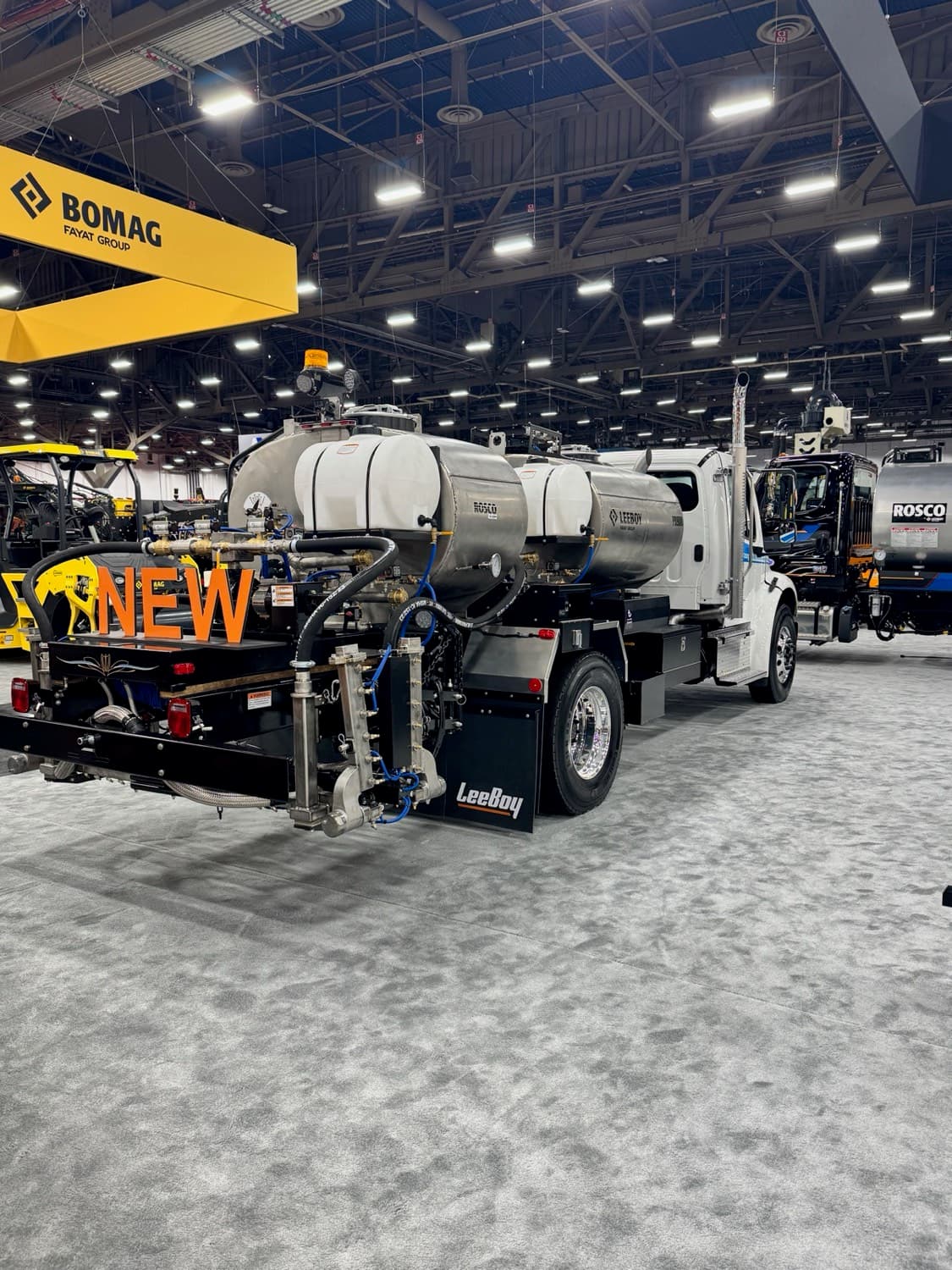
Dual Spray Bar Technology
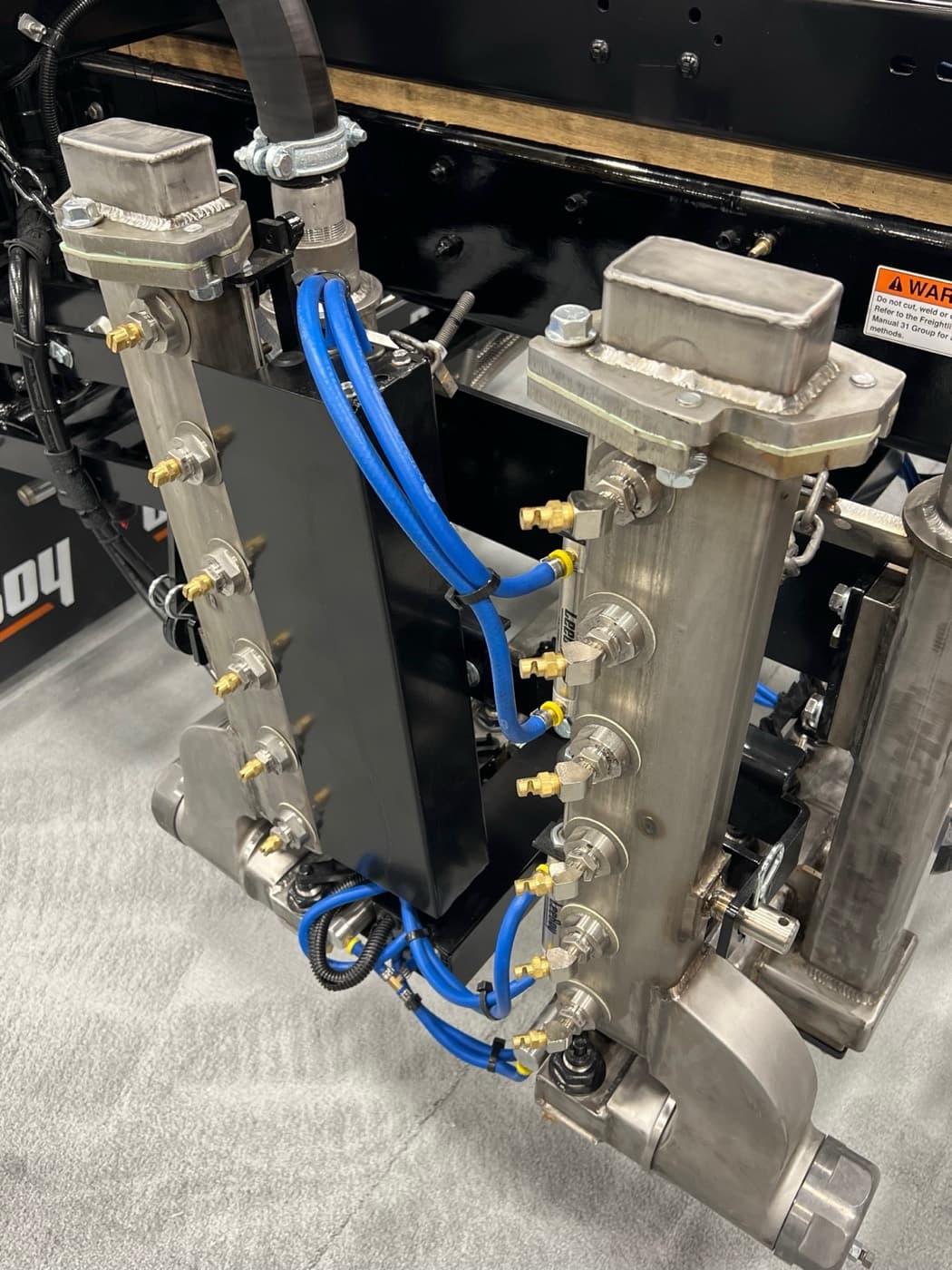
Chemistry That Wasn’t Possible
Every conventional distributor has one tank. Every multi-product treatment has meant one of two compromises: blend the materials and accept that both are formulated to coexist rather than to perform, or split the work into two operations. For decades, that single constraint decided what chemists were even allowed to formulate, because nothing gets developed that can’t survive in a tank.
The dual-system platform removes the constraint. Materials that could never share a tank, such as penetrating rejuvenators alongside polymer-modified binders, or reactive two-component systems that cure on contact, can now be applied together in one pass, each at its own rate, meeting for the first time on the pavement. It opens the door to a class of high-performance surface treatments that equipment, not chemistry, had been holding back.
How the Platform WorksIsolation Architecture
When two chemistries serve fundamentally different functions, a conventional distributor forces a compromise in formulation: it cannot deliver two independently metered liquid chemistries, and neither can a spray paver.
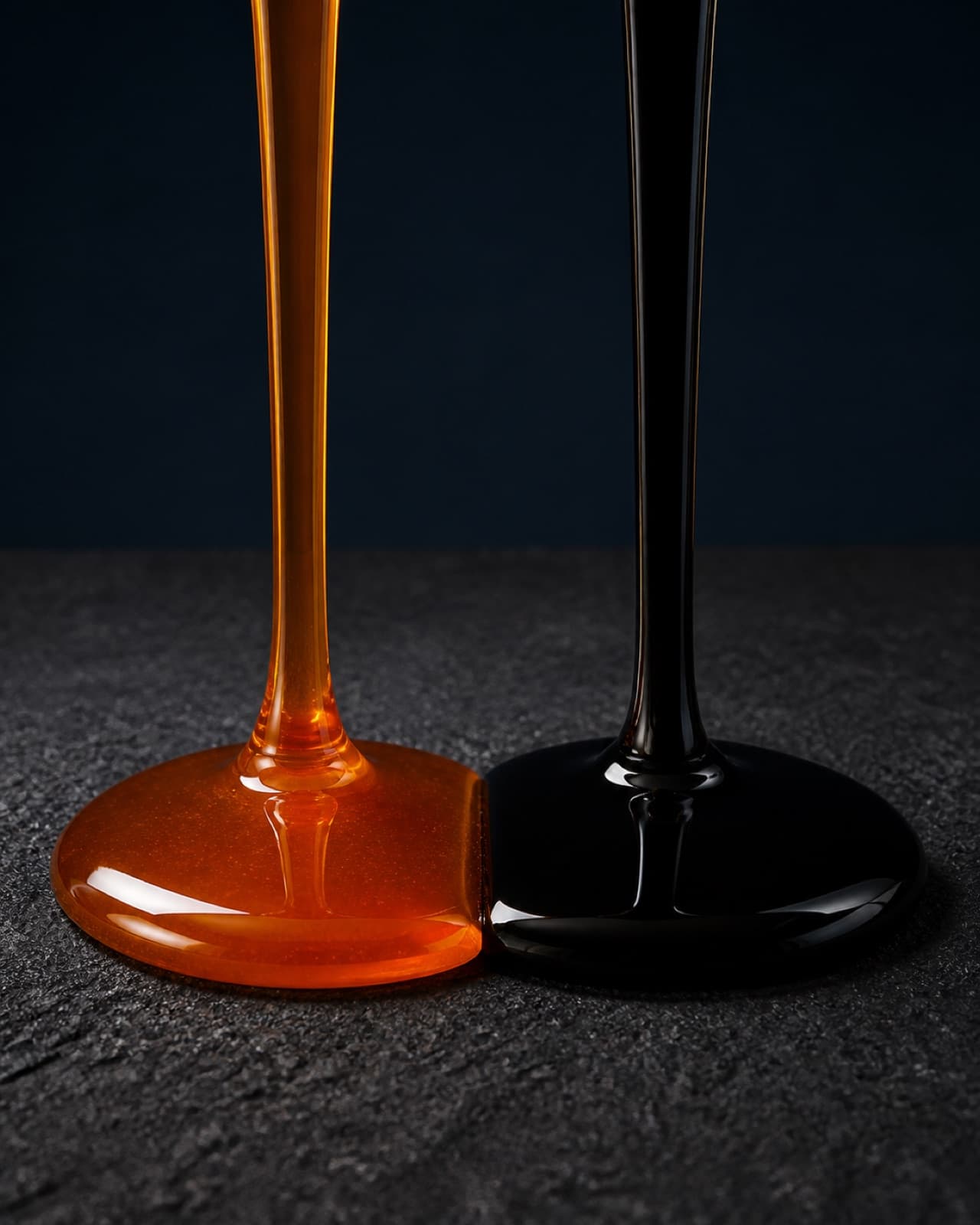
Separate tanks
Each material rides in its own tank. There is no blended material inside the equipment at any time. The two chemistries meet for the first time on the pavement.
Separate delivery paths
Each material travels an entirely separate, independently heated and calibrated path from tank to bar. No shared piping, no shared bar, no cross-contamination path.
Independent rate control
Each bar holds its own commanded rate, so the two materials keep their ratio in real time. The operator can adjust either rate in situ as texture, cross-slope, and curing conditions vary along the run.
A record of what was delivered
Onboard telemetry logs commanded and delivered rates for each bar, GPS-referenced by station and offset, reconciled against tank draw and a centralized computer system in the cab of the truck. A sample record is shown on the telemetry page.
Proven OEM Foundation
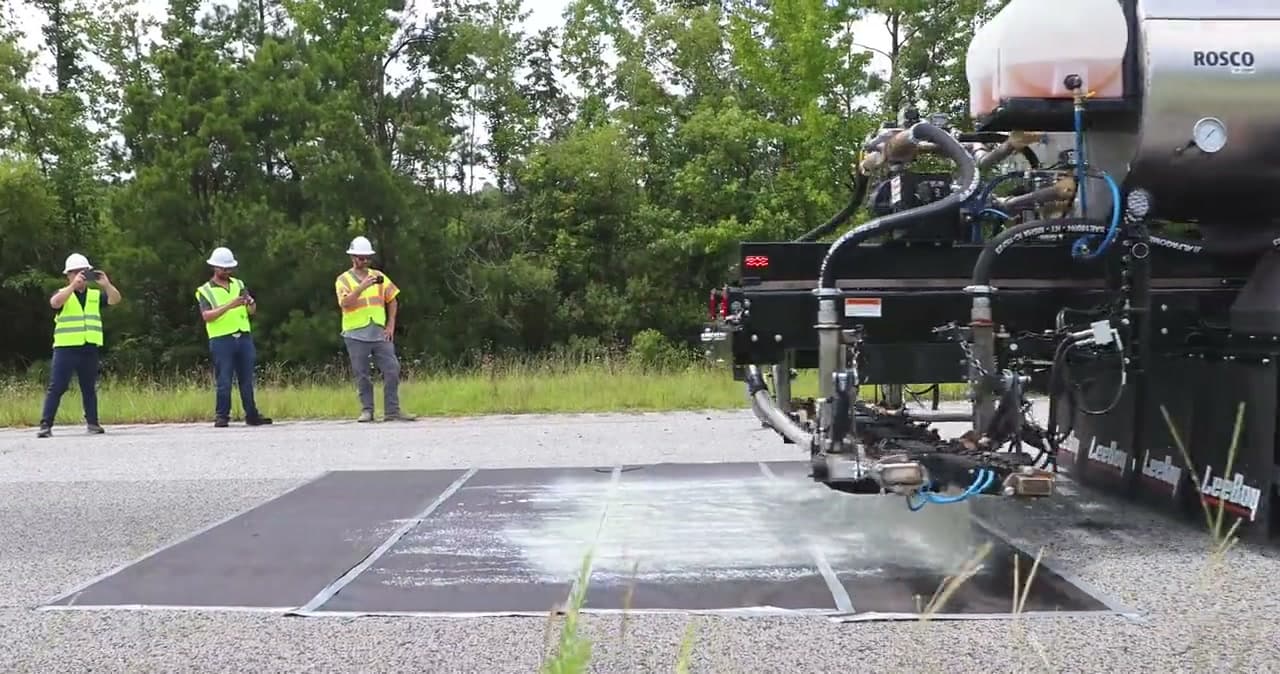
The platform is built on a conventional OEM distributor chassis. iEmulsions publicly announced the launch of the dual spray bar rejuvenating fog seal distributor at LeeBoy headquarters in Lincolnton, North Carolina, in October 2024. LeeBoy’s published PR900 specifications describe a dual-tank maintenance distributor: separate 600-gallon front and 300-gallon rear tanks, separate full-circulating spray bars, automatic in-cab application-rate control, stored rate presets, and radar ground-speed sensing.
Around the distributor, the operation stays familiar: for chip seal work, spreaders, rollers, and traffic control follow conventional practice. The change is confined to the machine that sprays, and to the record it produces.
Equipment description per LeeBoy’s published PR900 specifications, which are the manufacturer’s and subject to change. Outpave Surface operates its own equipment and self-performs all application work.
Transcript: LeeBoy PR900 asphalt distributor
So today, LeeBoy and iEmulsions, as well as Blacklidge, we’re all here at NCAT. It’s the National Center of Asphalt Technology. And so with partnerships through Auburn University, we’re here at the test track, unveiling this product. This is actually our second time out here. So in the infancy stages of this, we actually did a test track portion to prove the technology. And now we’re out here showing the refined approach to what we’ve done, finally having a production vehicle to do this. So that’s the brilliance of the LeeBoy PR900. And what LeeBoy has created is unbelievable.
Over time, asphalt binders oxidize and they become brittle. To impact the rheology means you make or improving the viscoelastic properties of an asphalt binder, and bio-based rejuvenators, specifically the one we just used here today on the NCAT track, do exactly that.
So NCAT exists to promote safe, sustainable, and durable asphalt pavements. Independent third-party evaluation of innovative products like this is absolutely critical. It’s a necessity to extend service life, but it’s also a necessity to get the most dollars out of a mile of roadway for American taxpayers.
Budgets are lower than they used to be. You’ve got to find ways to rejuvenate the asphalt, not just lay it down. So we want to be at the forefront of that to save the taxpayers money whenever we can.
With this new product, we have a way to extend those budgets across the life cycle of that paved road, and actually increase the amount of rehabilitation projects that can be funded throughout the course of the year.
This is a patented two spray bar system. So basically there’s a rejuvenation oil in the front tank, and then there’s a polymer in the back tank, and that polymer epoxy in the back tank is more of a sacrificial layer. Because they are oppositely charged, we can actually drive that rejuvenation oil deeper into the asphalt and re-molecularly bond the rock and the oil that’s there to give that surface the tension that it needs again to be safe for the traveling public, as well as then extend the life cycle of that actual surface oil.
So really what this does is it minimizes the amount of people on a job site. So you’ve got to have traffic control first and foremost to increase safety. But secondly, outside of the operator that’s running the truck, there’s really nobody else that’s needed. And more so, this work can be done at nighttime.
With the dual spray bars, you have a rejuvenator and a polymer. A polymer allows a DOT to open a highway in under an hour or an hour and a half. Whereas if you just spray a rejuvenator, you would have to keep the road closed for a long period of time.
We have a tracking system that offers telemetry for the Department of Transportation. And that telemetry gives you within one one-thousandth of an error on the application rate of each individual bar.
Our most heavily traveled highways, those asphalt pavements, make up about 550,000 miles of highways in the U.S. This product extends the service life of it by a minimum of 25% and up to 70%.
Right now we’re open to orders and we actually have several, both in the U.S. and abroad, that have come to CONEXPO and other various demos that we’ve done, and talking about this technology. And we look to see four or five units rolling out this year and numbers just rapidly increasing after that.
LeeBoy is the leader in R&D in the asphalt industry.
Transcribed from the film’s audio; statements are the speakers’ own. Speakers are identified on screen.
Download transcript (PDF)Transcript: LeeBoy’s commitment to training at NCAT
Today, LeeBoy and iEmulsions, as well as Blacklidge, we’re all here at NCAT. It’s the National Center of Asphalt Technology.
So NCAT exists to promote safe, sustainable, and durable asphalt pavements. Most DOTs, they are extremely interested in using the latest technology, but sometimes for various reasons they’re unable to test it themselves, and they just don’t accept data coming from the technology providers. Third-party labs, unbiased, will test products and write reports and publish results without really any skin in the game.
So the technology that we were applying today is an attempt to try to improve the durability and extend the lifespan of open-graded friction courses.
In a single day, cumulatively, our trucks will drive from coast to coast in the United States. Since 2000, we have accumulated over 12 million miles.
This sermon is being preached at the National Asphalt Pavement Association level. Pavement preservation has to be a part of a regimen of asphalt paving operations. It’s a necessity to extend service life, but it’s also a necessity to get the most dollars out of a mile of roadway for American taxpayers.
The beauty with any new concept and any new product is there’s always skepticism, but the beauty of being here at NCAT, being with Auburn University, and having the trials to prove this technology.
When you come to someplace like NCAT, they’ve been testing for decades, so you get to see what different states want in different levels. If you test outside your back door, you create a product that’s only for outside your back door. We’ve got to find out what do these governments want, what do the contractors want, and where is the evolution of that going.
Plus, you’ve got the resources of the engineers here at NCAT to say, hey, we’ve tried this, this works, this doesn’t work, this is what this customer wants. Come here, we’ve got a mile and a half test track to help you out with that stuff. And they can simulate millions of miles of traffic in a shorter amount of time because they’ve got these heavy trucks that are running at 50 miles an hour all day, every day.
What’s really nice about the test track is it’s not just test tubes in a lab. We like to think of it as America’s pavement proving ground.
LeeBoy is the leader in R&D in the asphalt industry.
Transcribed from the film’s audio; statements are the speakers’ own. Speakers are identified on screen.
Download transcript (PDF)Method Patents
The rejuvenator-then-binder application method is patented under U.S. 11,124,926 and 11,634,875. Both are method patents covering the dual spray bar application process.
- Granted
- September 21, 2021
- Assignee
- iEmulsions Corporation
- Family
- Parent of US 11,634,875
- Granted
- April 25, 2023
- Assignee
- iEmulsions Corporation
- Family
- Continuation-in-part of US 11,124,926
Issued patent records are public at the United States Patent and Trademark Office under the numbers above.
Start with a Pilot
A research pilot or experimental feature is the simplest way for an agency to evaluate the platform on its own network.